
- Understanding the Vintage Customer
- Creating a Distinctive Brand Identity
- Effective Visual Merchandising
- Digital Strategies in the Vintage World
- The Customer Experience in Vintage Retail
- Strategic Sourcing and Curation
- Targeted Pricing Strategies
- Building Community and Engagement
- Online Marketing and Valuable Content
- Restoration and Value-Added Services
- Sustainability as a Competitive Advantage
- Diversification and Innovation
- Conclusion: Embracing the Future of Vintage
Introduction
The vintage clothing market has experienced unprecedented growth in recent years, fueled by increasing environmental awareness, the desire for uniqueness, and the rediscovery of the historical value of vintage garments. For those operating in the sector—both wholesalers and retailers—attracting and retaining customers requires targeted strategies that enhance the distinctive characteristics of this fascinating and evolving market.
Understanding the Vintage Customer
The first step in developing effective strategies is understanding who the vintage market customers are. We can identify several profiles, each with specific purchasing motivations:
Collectors seek authentic pieces from specific eras or designers, investing significant sums for rare, well-preserved items that enrich their passionately curated collections.
Fashion enthusiasts see vintage as a way to stand out and interpret contemporary trends through unique pieces, thus expressing their personality in an authentic way.
Eco-conscious consumers choose vintage primarily for ethical and environmental reasons, as a response to the fashion industry’s impact on the ecosystem. They appreciate transparency about the origin of garments and sustainable practices.
Bargain lovers are attracted by the possibility of finding premium materials and craftsmanship at a fraction of the original cost, carefully evaluating the price-quality ratio.
Creating a Distinctive Brand Identity
In the competitive world of vintage, a strong brand identity is essential to stand out from the crowd. This process begins with defining your positioning: specializing in a specific era, a particular style, or certain types of garments allows you to become a reference point for a specific customer segment.
Developing a consistent aesthetic that reflects this positioning involves visual elements, tone of voice, and product presentation. A store specializing in 1950s fashion, for example, will benefit from an aesthetic inspired by mid-century design to create an immediate connection with the customer.
Storytelling is fundamental in the vintage sector, where each garment has a history. Building a narrative around your business—related to the founder’s passion, the mission to preserve tailoring techniques, or commitment to sustainability—creates an emotional dimension that transcends the simple commercial transaction.
Effective Visual Merchandising
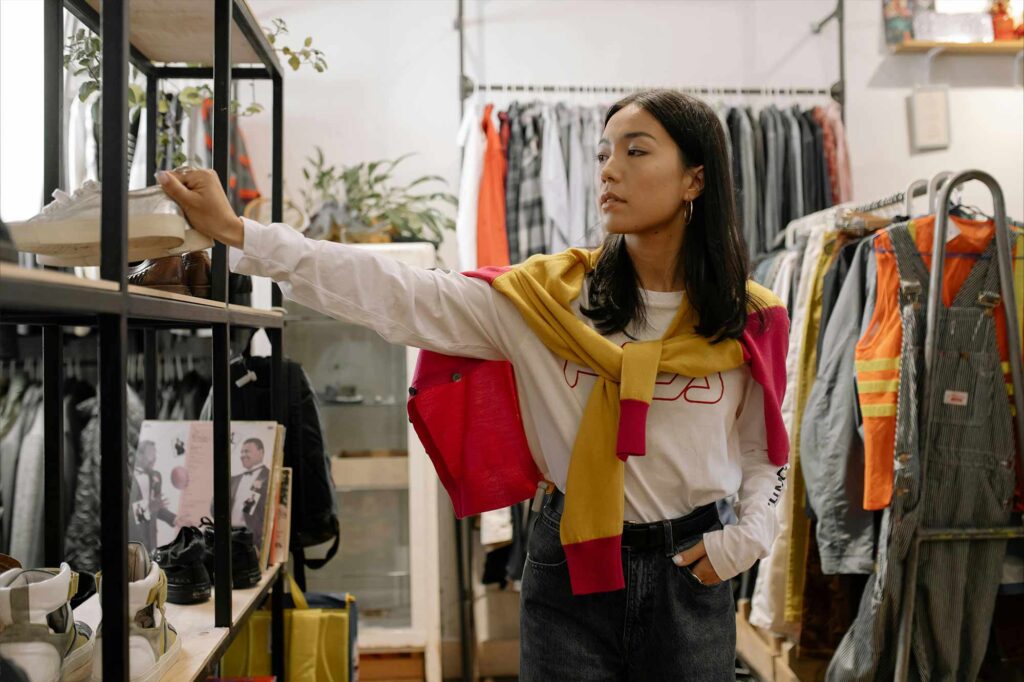
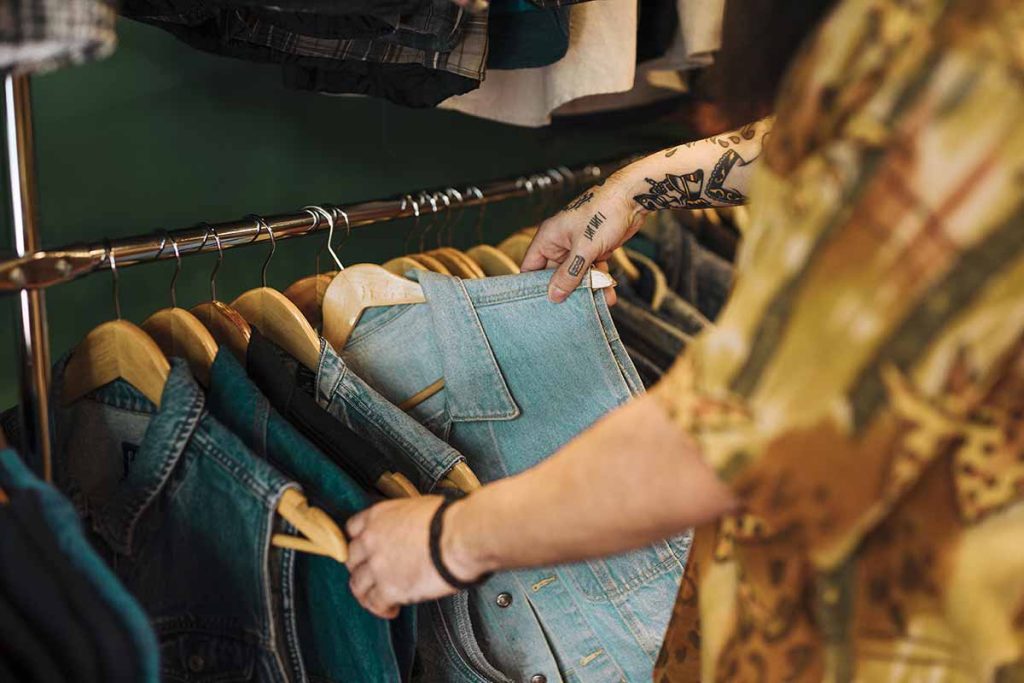
For physical stores, visual merchandising is a powerful tool to attract customers and stimulate purchases. The organization of space should facilitate exploration and discovery, key elements in the vintage shopping experience. Division by decades, styles, or colors helps customers navigate, while maintaining an element of surprise that stimulates curiosity.
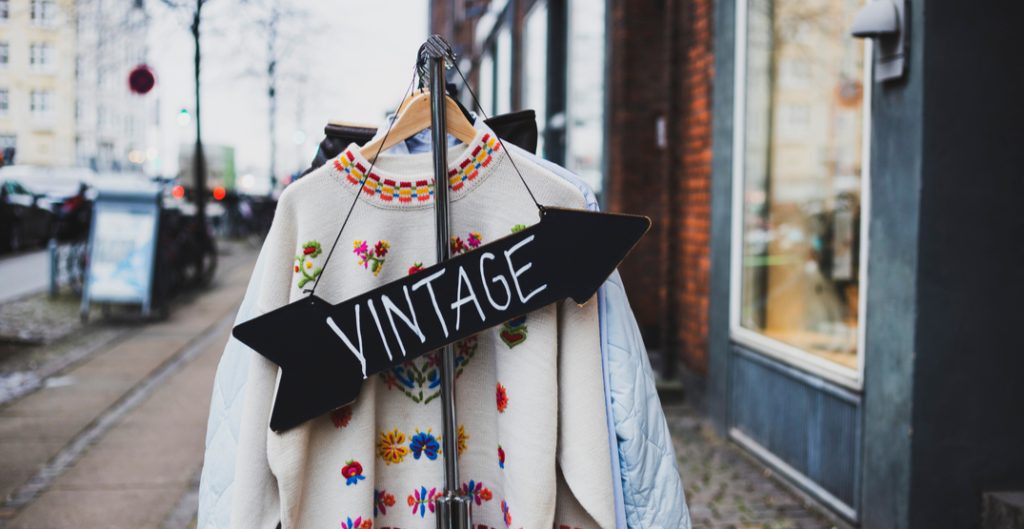
Window displays represent the first point of contact with potential customers. In vintage, it’s more effective to create arrangements that tell a story or evoke a specific era, rather than simply displaying individual garments. An environment that recreates a 1960s living room with models wearing period clothing immediately transports the observer to another temporal dimension.
Lighting plays a crucial role: excessively intense light can highlight imperfections, while overly soft lighting can hide important details. The ideal is to combine warm ambient light with spotlights to highlight particular pieces.
Digital Strategies in the Vintage World
Despite the importance of the physical experience, digital strategies are essential to expand business reach. The website should reflect the same care as the physical store: for wholesalers, a well-organized catalog with detailed descriptions is essential; for retailers, the site can serve as both e-commerce and a tool to attract visitors to the store.
Vintage e-commerce presents specific challenges related to the uniqueness of each item. Investing in high-quality photographs showing the garment from different angles, with details on texture and labels, is fundamental. Descriptions should include information about era, designer, materials, condition, and exact measurements.
Social media are powerful tools for creating communities around a passion for vintage fashion. Instagram is ideal for showcasing the most interesting pieces and creating themed shoots; Pinterest can generate organic traffic thanks to its “discovery” function; TikTok allows reaching a younger audience through educational content about vintage fashion.
The Customer Experience in Vintage Retail
In the vintage sector, the shopping experience goes well beyond the simple economic transaction. The store atmosphere should evoke a sense of exploration and discovery: period music, subtle scents, decor consistent with the historical period of specialization contribute to creating an immersive experience.
Staff plays a crucial role: sales associates must be knowledgeable about fashion history and able to provide detailed information about the garments. The ability to share anecdotes about the era, suggest contemporary pairings for vintage pieces, and recognize the authenticity of items transforms the salesperson into a true style consultant.
A personalized service can make the difference: searching for specific items on request, offering notifications when pieces matching customers’ interests arrive, or providing personalized styling consultations make the customer feel special and valued.
Strategic Sourcing and Curation
In the vintage sector, the quality and uniqueness of the offering are crucial for success. Supply sources are numerous: vintage fashion auctions offer rare and designer pieces, secondhand markets can hold unexpected discoveries, direct contacts with historical families or former employees of fashion houses can provide access to private collections.
For wholesalers, relationships with international suppliers are essential to ensure a constant supply. The ability to negotiate bulk purchases of vintage clothing by the kilo requires expertise in quickly assessing the quality of large quantities of garments.
Curation is the art of selecting a coherent collection that reflects the brand’s vision. In vintage, it means evaluating each garment in terms of condition, authenticity, historical relevance, and consistency with your positioning. A store specializing in American workwear from the 1940s-50s, for example, will carefully select denim and work jackets from that period, discarding pieces that don’t fit their narrative.
Targeted Pricing Strategies
Determining the right price for vintage garments is one of the most complex challenges. Unlike new clothing, each piece is unique and its value is influenced by numerous subjective and objective factors.
Rarity is a key determinant: iconic designer garments produced in limited editions, pieces that belonged to celebrities, or simply models that are difficult to find in good condition can command significantly higher prices.
The condition of the garment strongly influences the price: a 1950s dress in mint condition, with the original label and no signs of wear, can be worth much more than a similar piece with visible defects. It’s important to develop a consistent system for classifying the condition of garments and applying it transparently.
Market demand for specific styles, eras, or designers fluctuates over time, influenced by contemporary trends, historical anniversaries, or media references. Monitoring these trends allows for dynamic price adjustments.
Building Community and Engagement
Vintage is not just a type of clothing, but a true passion that unites people with common interests. Building a community around these values can transform a commercial activity into a cultural reference point.
Events represent a powerful tool: themed evenings dedicated to specific eras, with appropriate dress code and period music, transform shopping into an immersive social experience. Educational workshops on fashion history or techniques for identifying authentic pieces attract enthusiasts and collectors.
Collaborations with influencers specialized in vintage fashion can extend the reach of the message. The key is to identify authentically passionate personalities with in-depth knowledge of the sector.
Loyalty programs take on a particular dimension in vintage: early access to new collections, invitations to reserved events, or private shopping sessions are incentives that value the relationship beyond the transaction.
Online Marketing and Valuable Content
Creating valuable content is a long-term strategy that positions the brand as an authority in the sector. Blogs, podcasts, or videos that explore fashion history, techniques for recognizing authenticity, or vintage styling tips attract an interested audience and build trust.
Email marketing remains effective, especially for wholesalers: regular newsletters can inform customers about new arrivals or special collections. List segmentation allows for personalized communications based on the specific interests of different customer types.
SEO (Search Engine Optimization) requires particular attention in the vintage sector, where search terms can be very specific. Optimizing content for keywords such as “1970s Dior dress” or “pre-1980 Levi’s 501” can attract highly purchase-oriented customers.
Restoration and Value-Added Services
Restoration and maintenance represent valuable skills in the vintage sector. The ability to respectfully intervene on garments—fixing small defects, replacing missing buttons, or reinforcing seams—without compromising their authenticity allows for recovering pieces that would otherwise be unusable.
Offering restoration services, custom alterations, or consultation on the preservation of vintage garments creates an additional source of revenue and loyalty. Some successful retailers have developed actual schools to pass on traditional tailoring techniques, positioning themselves as custodians of artisanal knowledge.
Sustainability as a Competitive Advantage
The natural link between vintage and sustainability represents a strategic opportunity in an era of increasing environmental awareness. Communicating the positive impact of purchasing vintage garments in terms of resource savings and waste reduction can attract eco-conscious consumers.
Concrete initiatives such as recycling programs, collaborations with environmental organizations, or workshops on “repair and reuse” strengthen this positioning. Some vintage retailers have introduced ecological footprint measurement systems, quantifying the environmental savings generated by purchasing second-hand items compared to new ones.
Diversification and Innovation
Once established, vintage retailers can consider various diversification strategies: expanding the range to include accessories or home decor, developing contemporary clothing lines inspired by vintage, or offering complementary services such as vintage clothing rental for special events.
Innovation can also manifest in the adoption of new technologies: apps that allow discovering the history of a garment by scanning the label, augmented reality for “virtually” trying on garments, or blockchain-based authentication systems to guarantee the originality of valuable pieces.
Conclusion: Embracing the Future of Vintage
The vintage market is constantly evolving, influenced by social, technological, and cultural trends. Successful retailers will be those capable of maintaining authenticity and passion for fashion history while adapting to new modes of consumption and communication.
The growing hybridization between physical and digital, past and present, commerce and culture offers unprecedented opportunities for those who know how to interpret vintage not just as a merchandise category, but as an approach to fashion that celebrates quality, durability, uniqueness, and history. In an industry rediscovering the value of circularity, vintage retailers have the opportunity to position themselves not only as sellers but as pioneers of a more conscious and sustainable way of dressing and consuming.